
Answers to 5 common questions auto repair shops have about AI
Two areas where AI can make a difference for repair shops are service bays and the back office, according to a webinar that’s part of the Joe’s Garage Online 2026 series
LAS VEGAS – October 14, 2026 – The adoption of artificial intelligence in repair shops more or less matches “broader industry patterns,” according to Jason Popillion, the founder and CEO of Cyphernova.
He compares “AI adoption to the earlier move from paper and carbon copy sheets to PCs. At the time, shops questioned whether they needed the new technology and whether it could be trusted. PCs eventually changed shop workflows, but it took years for that value to become clear.”
This time around, with AI, the path to value will be a whole lot faster.
Popillion shared his perspective on a recent webinar moderated by Doug Kaufman, an editorial director with Babcox Media. The webinar is part of the Joe’s Garage Online 2026 series – prepared by Babcox and sponsored by AAPEX.
Where AI can make a difference for shops
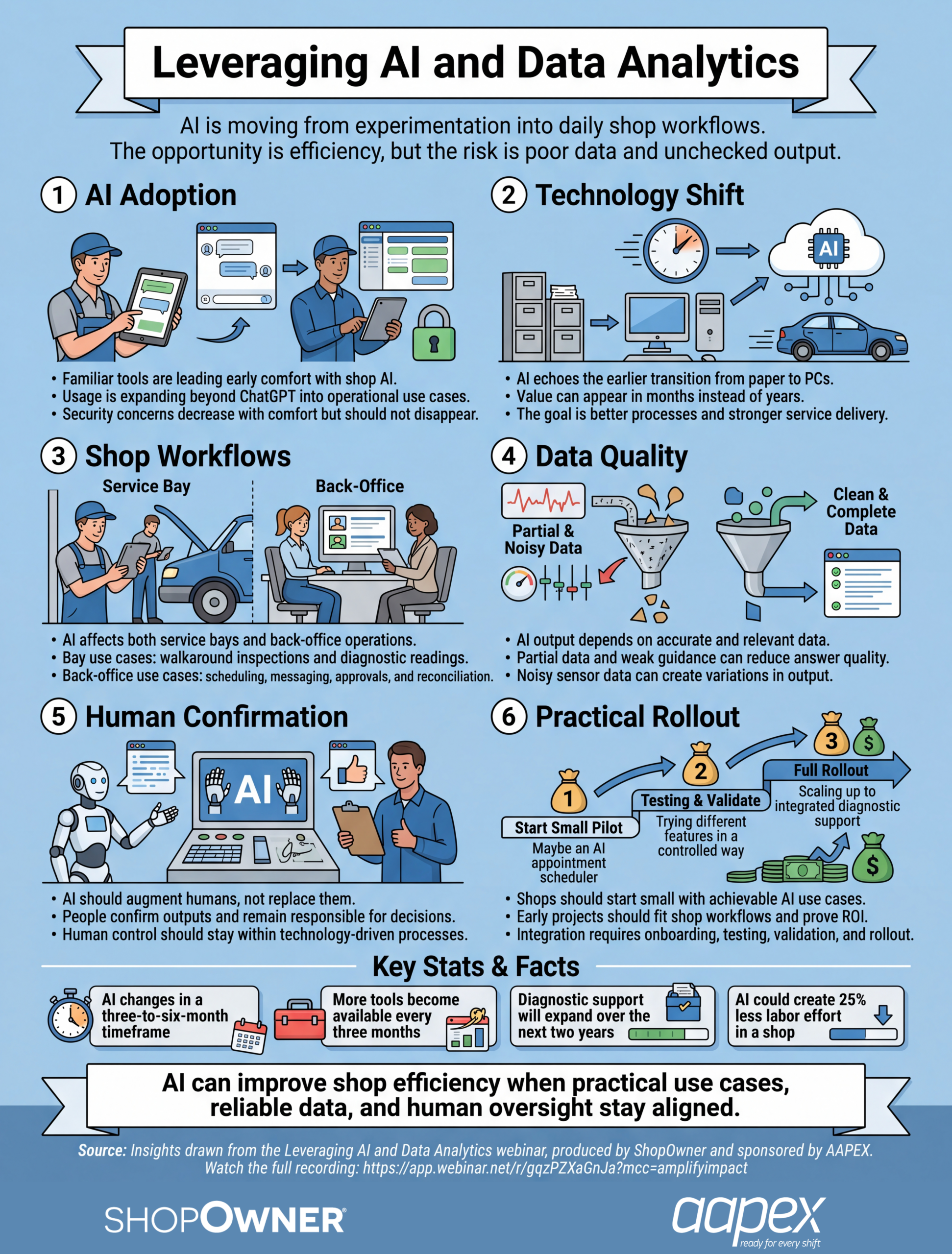
According to Popillion, independent repair shops have “two primary shop domains where AI can have an impact: service bays and the back office.”
- Service bays. “In the bays, examples included camera-based vehicle walkaround inspections and diagnostic readings. These use cases connect AI to technician workflows, inspection processes and problem-solving support.”
- Back office. “Back-office examples included rebate management, invoice reconciliation, phone attendants, text messaging, scheduling and work authorization. These areas may not be as visible as diagnostic work, but they represent recurring administrative tasks that can affect shop efficiency and customer communication.”
FAQs repair shops have about AI adoption
The webinar answers a handful of frequently asked questions (FAQs) that repair shops have about AI. Below are five of those FAQs.
1. How is AI currently being used in automotive repair shops?
“Current shop AI use is led by ChatGPT, with some additional ancillary shop uses. Other examples include on-demand repair information, OBD code error analysis, voice-assisted phone services, and predictive parts ordering. These use cases show that automotive repair shops are beginning to adopt the technology and become more comfortable with it. As comfort rises, security concerns may drop, though security concerns should not disappear.”
2. What areas of an automotive repair shop can AI affect?
“AI affects both the service bays and the back office. In the bays, examples include vehicle walkaround inspections using cameras and diagnostic readings. In the back office, examples include rebate management, invoice reconciliation, automated phone attendants, text messaging, scheduling, and customer approvals. AI impacts these areas differently and for different reasons.”
3. Why is ChatGPT not the full picture of AI for automotive repair shops?
Many shops understand AI primarily through ChatGPT. ChatGPT is described as a foundation or base, not the full scope of what is possible. More value comes from building beyond that base into a platform. Examples include voice assistant agents, invoice reconciliation agents, and demand forecasting agents.
4. Where can AI diagnostics go wrong in automotive repair shops?
“AI can hallucinate, meaning AI can give an answer that seems right until the details are checked. Poor data, partial data, irrelevant data, or weak guidance can affect the quality of the output. Sensor data can be noisy and can create variations in answers. OEM lockout is another limitation because AI needs data to solve problems well.”
For that reason, “AI should augment technicians rather than replace technicians. The human always confirms the AI output and takes responsibility for the AI output. AI can give technicians a strong starting point with possible steps and areas to focus on. The technician still validates and acts on the information.”
5. What should an automotive repair shop adopt first when starting with AI?
“Shops should start small with a use case that can succeed and produce ROI. Adopting AI only because people say a shop needs AI was described as the wrong answer. Possible starting points include call reception, scheduling, support inquiries, invoice automation, parts forecasting, diagnostic copilots, rebates, and purchase history analysis. The chosen use case should fit the shop’s data and workflow.”
Watch the full series on-demand
This particular webinar was part 11 of a 12-part series titled “AI Diagnostic Case Study.” While the webinar series concluded in September 2026, the recordings are available for your review any time on demand.
(click image for higher resolution)
* * *
AAPEX 2026 will be held from Nov. 3-5, 2026, in Las Vegas, Nevada, at The Venetian Expo & AAPEX Forum. See the exhibitor prospectus for exhibiting details. Complimentary passes are available to the media; email: [email protected].
If you enjoyed this post, you might also like:
Infographic: Understanding what auto techs want from employers [Joe’s Garage Online]