
The aftermarket has work to do to fix the technician shortage
2026 Voice of the Technician survey finds “77% of automotive technicians agree that higher pay is the biggest issue the industry needs to address”
LAS VEGAS – May 26, 2026 – Auto technicians might have a natural inclination to fix things, but the collective industry may well need to run some diagnostics to address the technician shortage – and focus on practical ways to strengthen the pipeline.
A handful of articles put the shortage up on a lift for inspection in recent weeks. This blog post plays the role of service advisor to let you know what we found, what the industry is hearing from technicians and educators, and where there are opportunities to better support the next generation of automotive technicians.
1. Cultural barriers to overcome
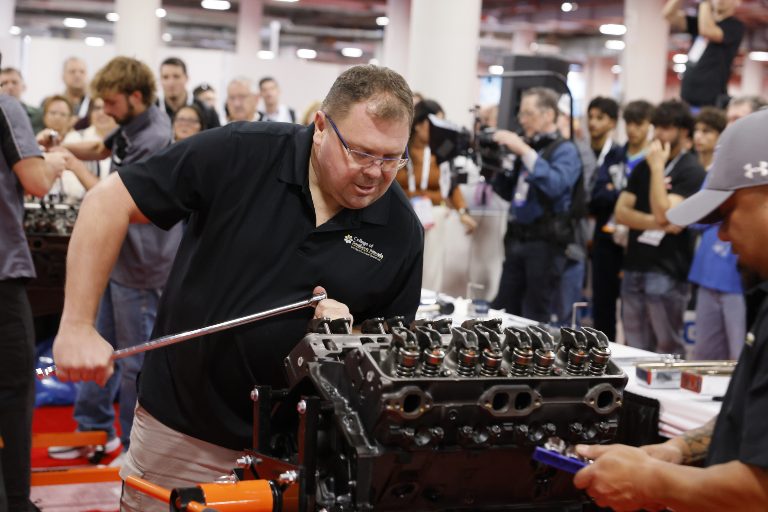
Jack Stow might be a familiar face in the aftermarket community. He’s an ASE-certified master automobile technician and an award-winning public educator with North Kansas City Schools. At AAPEX 2025, he coached a pair of his students at the show’s inaugural student competition – who won the competition.
One insight he shared recently in an op-ed published in The Kansas City Star is that young people don’t seem to have much interest in obtaining a driver’s license:
“A driver’s license used to be the pinnacle of teen independence. Meeting friends at the mall wasn’t just socializing – it was how young people learned confidence. Today, the malls are all but gone, and socialization happens on a phone.
That’s not criticism. It’s a reality. If cars aren’t a part of their daily life, it’s hard for them to imagine a career fixing them. Against that backdrop, I offer the following ideas for addressing the shortfall.”
Read more: The US needs more technicians. This KC school trains the next generation
2. “Harsh realities behind the automotive technician shortage”
Joe Henry recently shared some “harsh realities” in a commentary published by Auto Success. As the owner of ACT Auto Truck Tire Collision Staffing, he’s thinking about workforce challenges on a daily basis and takes exception to the notion that the biggest challenge for rebuilding the technician workforce is awareness.
He cites sources and doesn’t mince words in his piece:
“George Arrants, vice president, ASE Education Foundation, says, ‘Once students graduate and get into the industry, they face another challenge: More than 40% leave in the first two years.’ Following up is the new ASE president, Dave Johnson, on Sept. 3, 2025, who said on the Underhood Service podcast that 70% of young techs leave the industry. I saw that in my A.S.S.E.T. students.”
Why are newly minted technicians leaving?
“Call it ‘20/20/15.’ To get started in this industry, this is the baseline: $20,000 for your education, $20,000 for starter tools and the first year you make $15 per hour (Bureau of Labor Statistics). Result: Techs commonly come out of trade school cocky with 1.0 knowledge and find out they are expected to sprint to a 2.0 litmus test in a short time. Transitory to flat-rate with less than flagged 40+ hours consistently for months is a tech’s underwater predator.”
Read more: Technician shortage: it has a canary in the coal mine
(click image for higher resolution)

3. What 5,500 auto technicians have to say
“There are clear gaps between what technicians expect from their employers and what many are actually experiencing on the job.” That’s according to the 2026 Voice of Technician Survey Report by WrenchWay and ASE.
WrenchWay summarized some of the findings in a blog post – and the section on “What automotive technicians think about the industry” stood out:
- Compensation is an issue. “77% of automotive technicians agree that higher pay is the biggest issue the industry needs to address.”
- Leadership gaps. “Aside from pay-related issues, automotive technicians believe that better management is needed in order for the industry to improve.”
- Culture. “79% of automotive technicians do not believe the industry is improving.”
- Risk of technician attrition. “23% of automotive technicians say they will probably leave the industry in the next five years (not because of retirement).”
The findings are rightfully candid, but they also point to clear opportunities: modernize how we talk about the work, better support entry-level technicians, and show students that automotive training can open doors across the entire aftermarket – from the service bay to sales, marketing, operations, product management, and leadership.
A previous blog post we published about this report shows what auto technicians want from employers. Among the top benefits that employers can act on fairly quickly are having proper equipment in the shop (87%) and paid training (66%).
Read more: Automotive technician statistics (2026): job satisfaction, pay & industry trends
Training resources for technicians at AAPEX
We’d hasten to add that training is both important to technicians and a business investment for employers – and AAPEX 2026 has a packed training schedule full of opportunities.
The show is also a place to introduce students and entry-level technicians to the scale and sophistication of the aftermarket, where technical skills can lead to roles across repair, manufacturing, distribution, product development, sales, marketing, operations, and more.
The technician shortage will not be solved overnight, but the industry can make progress by telling a stronger career story and investing in the people who keep vehicles moving.
* * *
AAPEX 2026 will be held from Nov. 3–5, 2026, in Las Vegas, Nevada, at The Venetian Expo & AAPEX Forum. See the exhibitor prospectus for exhibiting details. Complimentary passes are available to the media; email: [email protected].
If you enjoyed this post, you might also like:
Pragmatic ideas for solving the skilled labor shortage from a California shop owner [guest post]