
Pragmatic ideas for solving the skilled labor shortage from a California shop owner [guest post]
March 31, 2026
Demand for repair work is outpacing the supply of auto technicians; without a course correction, waiting time for service will grow, the cost will rise, and shops that are unable to recruit technicians may close
LAS VEGAS – March 31, 2026 – You’re driving up Highway 1 and enjoying the California weather when your check engine light illuminates. You depend on your car, so call your local repair shop and make an appointment. Within a couple of hours, your car is repaired, and you’re back safely on the road.
Few people enjoy a trip to the auto repair shop, but many of us take the quick turnaround for granted. That is poised to change if we can’t solve the shortage of skilled labor in the U.S.
A dire need for auto technicians
The skilled labor shortage has hit the auto industry hard. Ford CEO Jim Farley recently noted his company has 5,000 six-figure jobs for technicians that the company cannot fill.
That’s just the tip of the proverbial iceberg. Manufacturers, like Ford, account for just 30% of the repair capacity. The 270,300 independent repair shops account for the other 70%, and they face the same shortage.
Simultaneously, demand for repairs is rising. The average age of the 291 million vehicles is 12.8 years and climbing. Older vehicles require more maintenance.
The consequences are real. Waiting time for appointments will grow, the cost will rise, and shops that are unable to recruit technicians may close.
Generational influences have shifted
This talent shortage has grown steadily for a decade, along with the profound influence technology has had on our culture.
For example, I grew up with a favorite California pastime: riding dirtbikes. These wondrous machines captured my imagination at a young age. It came with responsibility, too, as my father required me to learn how to perform the maintenance.
Although I considered a career as a mechanical engineer, fixing dirtbikes influenced my decision to attend trade school. In effect, a youthful hobby inspired my career choice.
Kids today grow up with phones. They learn to play games and connect with friends on social media. They don’t even get an introduction to the trades.
Five ways to address the technician shortage
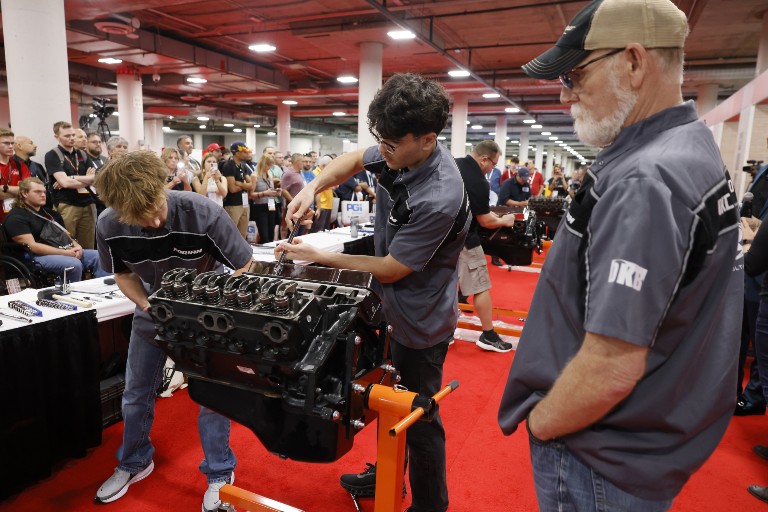
Some good things are happening. For example, various initiatives are underway to bring traditional college-bound financial aid to the trades. Several organizations, including Ford, are offering trade school scholarships. Last fall, I led an effort by AAPEX, an industry trade show, to organize the inaugural student engine assembly competition.
We need these initiatives, but they will require time to produce results and America can’t wait; we need to be proactive in getting ahead of the issue now. Below are some ideas for tackling this challenge.
1. Work to change the perception of auto technicians
There’s a stigma associated with trade craft. It’s perceived as dirty work for people who aren’t smart enough for college. Nothing could be further from the truth. We refer to them as “auto technicians” rather than “mechanics” to reflect the cerebral evolution.
The knowledge, technology, and tooling required to fix vehicles are progressing fast. Problem-solving is an essential skill. There are more lines of software code in modern vehicles than in some airplanes. AI is everywhere. Modern technicians spend more time with sophisticated diagnostics than turning a wrench.
Changing the perception is a matter of educating the public about this $435 billion U.S. market. Career options include mastering the trade, hanging a single of your own, or working for one of the thousands of related companies in manufacturing, logistics, and technology.
2. Tech compensation needs to evolve
Auto technicians are usually paid a flat fee for a given job. If a brake job takes two hours on average, that’s what the technician is compensated for, regardless of how long it actually takes.
Assuming a repair shop is busy, a seasoned technician will finish in less time and tackle another. It incentivizes productivity and a good auto technician can easily earn six figures.
For an entry-level technician, the same job will take them longer for the same pay. That might seem unfair, but it’s the industry standard and was recently upheld by a California appellate court.
My shop addresses this with a base salary in addition to the flat fee. The productivity incentive remains, but my new technicians earn a living wage as they gain experience.
It’s both an investment in talent and management of risk; I can’t have a new technician rush through a job and have the vehicle come back.
3. Shop culture has to change
When I was coming up, working in a shop was like boot camp. Expectations were high, continuing training was rare, and promotions were abstract. Today, young people crave a sense of purpose. They thirst for continuing education. Employers must outline a clear career path with achievable milestones.
Culture extends to the employee experience. At a minimum, a shop must be orderly, comfortable and climate-controlled. Many repair shops have completely remodeled their customer waiting areas. The workspace is the next logical progression.
4. Shops need to be ‘good citizens’
Repair shops need to be active in their local communities. My shop is a Silicon Valley Chamber of Commerce member, participates in community events, and sponsors the 49ers Cal-high Sports program. That program selects the ‘player of the week’ who is recognized with all sorts of tchotchkes. We provide high-end Bluetooth headphones with our logo and name on them.
These initiatives build awareness among prospective customers and plant seeds in the minds of young athletes. They’ll embark on a career one day, and I’d like them to consider automotive repair. I know it’s working because the winners get curious and investigate our business.
Countless smaller youth organizations would welcome sponsors. It’s about opening a door to a career that kids might never otherwise consider. That’s a crucial first step to breaking the stigma.
5. The lack of trade exposure is an opportunity
Over the last 20 years or so, schools have phased out shop classes. Students today have little exposure to metalworking, wood, or other trade crafts. I would wager the average high schooler would struggle to change a flat tire.
This is an opportunity. Any shop can reach out to local schools to organize field trips, apprenticeships, internships or even offer to provide a tire-changing seminar.
It could be a formal agreement with a school, or an informal program, like an open house. For example, hosting a short seminar on a Saturday afternoon, inviting the public, and providing basic tips and tricks for keeping their vehicles operating smoothly.
Bernard Tansey is the owner and chief operating officer at Santa Clara, Calif.-based Euro Clinic, which specializes in European and exotic vehicles.
An earlier version of this post was first published in the San Francisco Business Times.
* * *
AAPEX 2026 will be held from November 3–5, 2026, in Las Vegas, NV at The Venetian Expo & Caesars Forum. See the exhibitor prospectus for exhibiting details. Complimentary passes are available to the media; email: [email protected].
If you enjoyed this post, you might also like:
Auto tech shortage presents a career opportunity in a well-paid trade