
Should shop owners get into the EV repair business?
“We’re in the business of fixing people’s personal transportation,” says Seth Thorson, who will be leading a class on Tesla networks for shop owners and technicians at AAPEX 2026
LAS VEGAS – July 21, 2026 – As AAPEX 2026 draws closer, we are interviewing some of the speakers who are providing training at this year’s show (see the training schedule). We recently caught up with Seth Thorson, who is the president and CEO of Eurotech Auto Service, which has five repair shops in the Minneapolis area.
Seth has been teaching at AAPEX for several years now, and his classes are always popular. He’s a great resource for learning about tech trends, including AI for shop owners, as well as EVs and Tesla. At the show this year, he will be presenting a session titled Tesla Vehicle Networking: CAN, Ethernet & Hands-On Testing.
During our conversation, we asked him some questions about his class and about the EV market in general. Below is what he had to say.
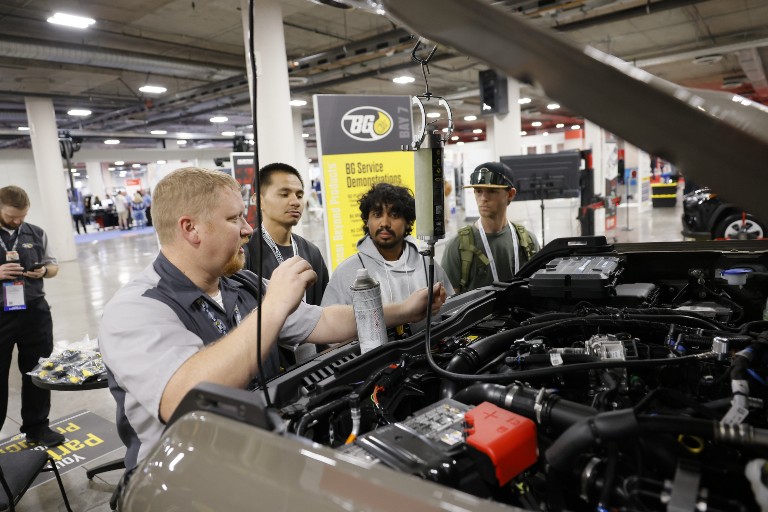
Q: What is the class you are presenting at AAPEX 2026 about?
ST: “We’re going to cover all the networks that Tesla vehicles use, such as CAN bus, FlexRay, LIN and Ethernet, along with the voltages and other related information that technicians and shop owners need to know, such as:
- real-world problems you might have with these networks;
- how to scope the network and solve some communication issues; and
- in-depth testing and information on the CAN bus.
This is important because we’ve had a few cars in my shop that had some unusual CAN and LIN bus issues that, frankly, Tesla and other technicians had misdiagnosed. This class will teach technicians how to solve these problems using oscilloscopes and data.
We didn’t see a lot of bus issues when Teslas were new, but as cars age, we start to see things like moisture, erosion, wear and tear that happen when cars get old, and their parts start to get brittle.
This is new for the aftermarket because Teslas are just starting to come out of warranty and into the aftermarket – and we’re seeing issues that we’ve never seen before – that’s what this class is about.”
Q: How would you describe the business opportunity for electric vehicles (EVs) in the aftermarket?
ST: “I think there’s a huge business opportunity for independent repair shops to get into this market if they have a desire. I have five locations in the Minneapolis Metro area, and we have three to four Tesla vehicles every day at any given location.
The issues range from minor maintenance to wheel bearings – and from suspension to full-blown AC problems. We’ve also seen full-blown intermittent shutdowns caused by isolation from drive units that need rebuilding.
Obviously, getting into the market requires some training and safety classes. The good news is that there are only so many ways you can make electricity work compared to ICE engines. So, once you figure out electricity, you’ve figured out EVs.
That’s good for business because a lot of the other car makers are catching up too – Chevy, Ford and GM – all have EVs and I don’t think they are going away.”
Q: What advice do you have for shop owners who are hesitant to get into the EV market?
ST: “I think there’s hesitation anytime there’s new technology. Those who remember when fuel injection came out, there were shops that said, ‘We’re not going to get into fuel injection. It just won’t last.’ That wasn’t the case then and that’s not going to be the case with EVs now.
That said, EVs are slightly different because the massive EV adoption we saw a few years ago was being driven by governmental policies. That adoption has slowed as policies have changed. EVs are still only 3% to 6% of the overall U.S. market, but I don’t think they are going away.
This is a decision for an individual shop owner. There’s a similar parallel with ADAS. Many shop owners who didn’t get into ADAS are now starting to tiptoe in, saying, ‘We’re only going to do tires, brakes and minor maintenance stuff on them and none of the high-voltage work.’
So, viewpoints on EVs among shop owners are really all over the map, but I think many are starting to soften their stance and beginning to take on at least some of the minor work involved.”
Q: For a shop owner who’s trying to decide on EVs, what are the considerations they should have in mind?
ST: “Education. You’ve got to make sure your technicians are trained on high-voltage electricity. Safety is paramount. After that, it’s just learning a little bit more about them.
Historically, EV owners, especially Tesla models, were purchased by all early adopters. These people are technology geeks, and they know a lot about their cars. That’s beginning to change. The people buying EVs today are in the mainstream, and they don’t know as much about their vehicles, which can be a challenge for shops if they aren’t ready for it.”
Q: What educational resources do you recommend for shop owners and technicians?
ST: “Obviously we teach classes – including the session I’m doing at AAPEX 2026:
- Both NAPA and Worldpac offer classes.
- Weber State University has a three-day EV intensive program.
- ASE has its Level 1 and Level 2 certifications.
- Dave Mackiewicz has a pretty good program that offers hands-on training and tests.
There are a bunch of programs that make training available. You’ll find a lot of training available on the show floor at AAPEX, including EV safety.
Safety certifications tend to expire every three to five years because things change, so you’ve got to renew your safety certifications. However, once you know how to work with high voltage safely, the rest of an electric vehicle isn’t that scary. It’s just figuring out how to diagnose and repair it like any other vehicle.”
Q: Are there any myths or misconceptions shop owners might have about getting into the EV business?
ST: “Sometimes I hear that EVs don’t break, or you can’t get parts for them, or that Tesla doesn’t open up its service information – but that’s not true. Tesla does open its service information, and you can get parts, but you have to follow the right procedures.
EVs, including Tesla vehicles, don’t break down is another myth. They do break, but in ways a repair shop or technician doesn’t usually see.
You’re not fixing oil leaks – you’re fixing transaxle leaks. Many EVs still have an oil filter and while Tesla will tell you never to change it, the aftermarket community knows that lifetime fluids are not really a thing. So, there is still a need for services and maintenance.
There are some misnomers that the EV customers are cheap, but you could say the same thing about every ICE customer, too. And you’re going to get certainly some of those customers no matter the type of work you perform.”
Q: What’s the upside for shops that decide to start servicing EVs?
ST: “I think the upside to getting into EVs obviously is it’s just another car line for you to work on. It’s another car to get in the bay. As EVs become much more prevalent in the industry, it’s something you’ll probably need to do.
The way I look at it is we’re in the business of fixing people’s personal transportation. If they’re flying around on hoverboards, well, guess what? I’m going to fix their hoverboard.
Historically, it’s very similar to the advent of the automobile. The people who put horseshoes on horses didn’t realize they were in the business of fixing somebody’s personal transportation. When automobiles came along, and that person decided not to take up that line of business, they missed the point.
Our business is fixing people’s personal transportation; it’s not fixing cars. It’s truly fixing their personal transportation and how do we adapt to whatever’s in the market and make sure that we’re ready to continue to fix people’s mode of personal transportation.
* * *
AAPEX 2026 will be held from Nov. 3–5, 2026, in Las Vegas, Nevada, at The Venetian Expo & AAPEX Forum. See the exhibitor prospectus for exhibiting details. Complimentary passes are available to the media; email: [email protected].
If you enjoyed this post, you might also like:
The average auto tech bills just 5.2 hours a day